Showing posts with label pane e focacce. Show all posts

Wednesday, April 04, 2007

Tortano

I'm back, once again, with a savory bread for Easter. In Campania there are basically two savory breads for Pasqua: tortano and casatiello. The main difference between the two is that to qualify as a casatiello the bread needs to be decorated with 6 raw eggs on the shell which will be secured on top of the bread before baking with a cross of dough.
I have followed the recipe that Maria Letizia published on Gennarino forum, living out not just the eggs on top but also the salame and the pepper in the dough. Salame in cooking is very "napoletano" and I really don't like the taste of cooked salame. In general, I am sorry to say, cucina napoletana is not in my likings, I really find it too heavy and greasy. And I have a strange relationship with pepper, I like spicy food but I am very sensitive to pepper, it spoils the taste of food, for me, I only like it on mussels!
Maria Letizia recipe has the peculiarity to spead the lard and give turns to the dough to achieve a semi puff pastry effect. I have seen other recipes where this is not done and in the filling, just to lighten up the dough, apart from grated cheeses, cubed cheese, cracklings and salame there are also boil eggs in wedges evenly distributed on the dough before rolling.


You will need

600 g of bread flour
25 g of fresh cake yeast or 2 and half teaspoons of instant yeast
225 g lard (good lard!)
1 scanty tablespoon of salt
grated pecorino and parmigiano
150 g of provolone ( I used a caciocavallo)
If you decide to go with Maria Letizia recipe you'll need also 100 g of cubed salame napoletano to add with the cubed cheese, pepper and 6 eggs to secure on top of the bread.

Sift the flour add the yeast, 1 tablespoon salt, 50 g of soft lard and enough water to make a soft dough (about 350 g of water, more or less). Let proof in a warm spot until it doubles in bulk


I rolled out the dough to 1 cm thickness and spread 1/4 of the remaining lard with a spatula, sprinkle with grated pecorino and parmigiano.


I folded the dough in 3, like for puff pastry and let rest 20-30 minutes in the fridge. And you basically keep rolling the dough and folding until the lard it is used up, I manage in four times.


When you roll the dough out the 4th time, after spreading the lard, distribute on top the cubed cheese. And roll up tightly starting from the longer side.


Lenghten the roll to fit a 26 cm diameter (measured on top) tubed pan.


Let proof until it reaches the top of the mold. Brush with egg wash and bake in a preaheated oven at 180 C. Covering it with aluminum if it gets dark too quickly. It with take about 50 minutes, test the doness with a long skewer.


Let cool 5 minutes before unmolding and completly cool on a wrack before slicing.


Here how it come out


My impressions: the crust if really flaky, like for puff pastry, the crumb is really tender, soft, very good. But it is very, very rich. I tried it for the sake of trying a traditional food but to my taste is not something I could eat every day.

Wednesday, March 21, 2007

Pizza al formaggio di Pasqua

This year I decided to go on the Easter sweat and savory bread marathon. I finally succeed in getting a good pizza al formaggio. This cheese bread is very common in Umbria and Marche. I think something similar is also baked in Abruzzi (fiadone) and in Toscana (ciaccia, in Val D'Orcia with saffron and mixed spices). From what I read, this bread is called torta al formaggio in Umbria it's slightly denser in texture and traditionally without cubed cheese in it, just a mix of grated pecorino and parmigiano, in Marche it is called pizza al formaggio or crescia di Pasqua, it has more open crumbs and pieces of cheese which give the distinctive eyes to the crumb.

I think the recipe I come out with it closer to the marchigiana version. I didn't have the proper mold, which would be a tall tin cake mold with a bigger diameter at the top (kind of a charlotte mold) so I used a regular cakes spring form 20 cm in diameter with a parchment paper collar. For a 20 cm diameter mold I noticed that the amount of flour I should use it's in the range of the 350 g flour. As a preamble I should also add that as starter I have been using a biga which I have been refreshing daily for the last 20 days, it not like a stiff wild starter but it's working fine. If you don't have a wild starter, or a biga like mine sitting in your kitchen, you could make 12 hours before a "biga" starter mixing about 50 g strong flour and 30 g water and the tip of a knife of yeast, and let it proof covered at room temperature overnight

330 g strong bread flour (the one I used had a 12,9% protein content)
80 g biga refreshed daily (or at least a 12 hour biga)
70 g grated cheese grana or parmigiano and pecorino
65 g of emmental cheese (or better a young pecorino) cubed
2 whole eggs
1 yolk
30 g lard (if you don't have it make a mix of butter and oil)
15 g oil
25 g butter
1/2 teaspoon salt
1/2 teaspoon Saf Gold or other yeast (if you use fresh caked yeast about 10 g)

I kneaded the biga in chunks with 80 g of flour and enough water to make a medium soft dough. Left to double in bulk (it took about 2 and half hours). Meanwhile I beated the eggs and the yolk with the grated cheeses and the salt. Left to rest at room temperature. I soften the butter and lard and mixed with the oil.
Once the dough was doubled in bulk I put it in the stand mixer in chunks with the remaining flour, the egg mixture, the fats and the yeast, I had to add more water, sorry I didn't measure. When it was almost ready I added to the running machine the cheese in cubes.


As I previously said I used a regular spring form, buttered and reinforced with a parchment collar. The dough before rising was a little less the half of the height of the mold.
I covered loosely with wrap and let it proof in a warm place until it reached the rim of the mold. It took 6 hours.


I covered it looosely with foil and baked in a preheated oven at 170 C with vent (I don't have a static option) after 30 minutes I uncovered and let it cook and get a nice golden color about other 15 minutes. I tested the cooking with a long skewers. Let cool on a rack.


It is usually eaten on Easter with salumi or by its own.

Tuesday, January 16, 2007

Crescente or Tigelle

I have been away for long time and I have negletted my blog. It's time to recover the lost time.

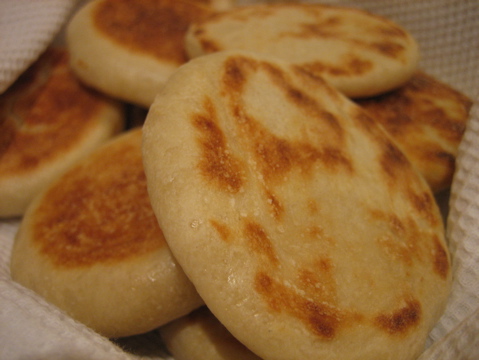
In Emilia, more precisely in the Modena area, a very rustic meal can be prepared with le crescente, as they call these tiny disks of bread in the mountains of the Appennino around Modena. Elsewhere they are known as tigelle, from the tigelliera, the pan used for cooking.
The names here can get very confusing, I'll try to clarify:

La crescente (singular) is a focaccia from Bologna, usually enriched with chopped salumi and lard in the dough.
La crescenta, singular, le crescente plural are these disks of bread we are talking about. They are known elsewhere as tigelle.
Le crescentine, in Bologna, are tiny bit of dough, deep fried. Elsewhere also known as gnocco fritto. IL gnocco fritto, notice the wrong article, they are very sensitive about the use of IL.

I have seen many different recipes for crescente, going from a very simple dough: flour, salt, oil (or lard/butter), yeast and lukewarm milk, to the use of a good amount of cream instead of plain milk. In some trattorie they serve them pretty thin (this way they'll create a pocket in the middle that is good for stuffing with salumi), the original I heard are generally thicker and were served with sausages or stews, etc. Nowadays they are very often eaten with a pesto (don't think of the ligurian pesto, it's minced lardo with garlic and rosmary), with stracchino and rucola, with salumi or even nutella.

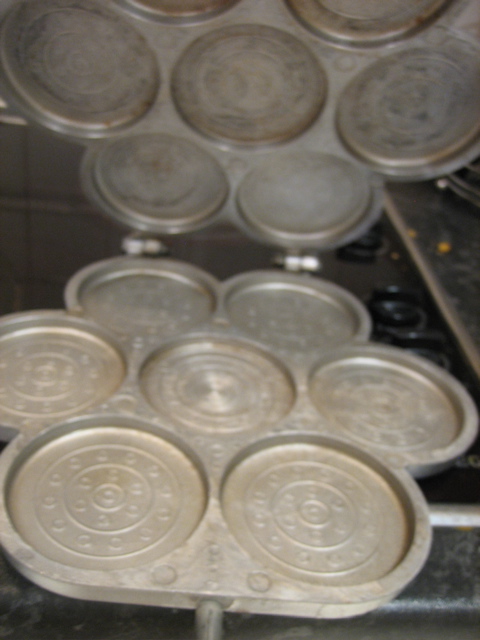
This is the tigelliera.
It's a very heavy cast-iron pan. This is a 7 disks tigelliera but you can buy a smaller 4 disks one. They are even electric tigelliere around. When the pan is pretty warm, on both sides, try with one tigella to test the temperature, adjust it if you need. Cook the crescente turning the pan. As soon as they are ready put them in a basket lined with a cloth to keep them warm. They don't keep very well and they are best eaten straight away, warm.


As you can see, with the tigelle in the pan I tried different thicknesses and I decided that I like them thinner, plus the cook better.
In this case the dough was
250 g of flour
2% salt
2 tablespoons of extra virgin oil
1 and 1/2 teaspoon dry yeast
and enough warm milk to get a soft not sticky dough.
Let rise until double in bulk. Divide into little balls (I would do no more than 15-20 grams each) flatten with a rolling pin to fit the disks of tigelliera and let proof covered.


Tuesday, September 26, 2006

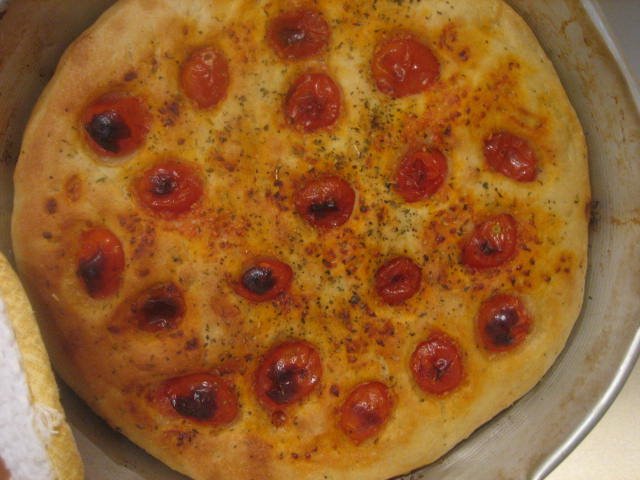
Focaccia Pugliese con i pomodorini

Focaccias in Puglia, where I am from, are our "fast food", there are stores where you can go just for focaccias and panzerotti and you will eat it standing outside with a beer. In any case you can buy warm focaccia in every bakery.
Think, when I was in middle school we had a cooffee place (bar in Italian) right inside the school, a girl in the morning would come and take orders for "pausa", the break, and most of us would order a stuffed focaccia or focaccia with pomodoro and mozzarella. At the break a basket from the bar would come to the class with warm focaccia, panini con mortadella or other stuff, in middle school we were not allowed to leave the classe during the break. Insteresting enough in my area we called focaccia even what in other parts of Italy would be a pizza. If it's taller and baked in a pan for us is always focaccia.
I have seen in the States replicates of this focaccia, the fault in the States is that is too tall making it resemble and taste more like a bread. This need to be cruncky on the side with the good taste of olive oil but still soft when eating.


250 g bread flour (or half durum flour)
190—210 g water
1 tsp salt
1 tsp instant yeast
extra virgin olive oil
cherry tomatoes
dry oregano


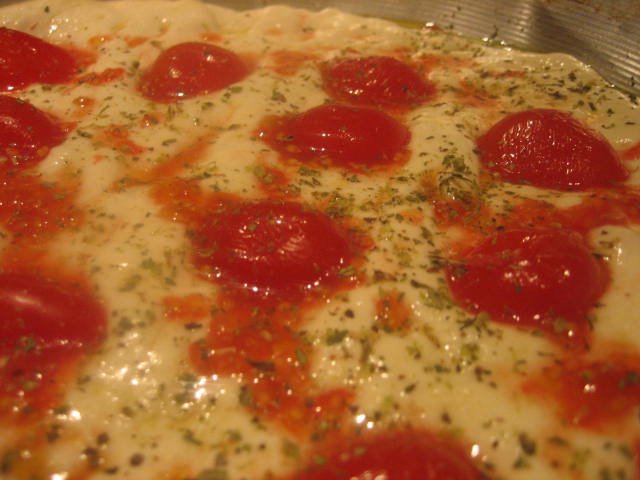
Put sifted flour in a large bowl and add salt and yeast, stat pouring water, the quantity of water is not fixed, dipending from many factors. With one arm keep the bowl,with the other start whisking the dough (like for wisking eggs with a fork). It will take about 15 minutes of work for the gluten to develope. Let triple in bulk, about 2 hours and half, depending on the temperature. Preheat oven at 230 Celsius. Pour in a pan oiled with evo and spread with oiled hands. Put cherry tomatoes in half, squeeze the juice over the dough and sink the half tomatoes in the dough. Sprinkle with crumbled dry oregano, drizzle with oil and bake in hot oven, about 20 minutes.
I do take particular care in the baking, brushing again with evo if I feel is necessary. One out of the oven I slide it on a grill and cover with a kitchen cloth.


  Posted by Picasa