Showing posts with label Dolci. Show all posts

Thursday, March 15, 2007

Pizza dolce di Pasqua from Pesaro


Another sweat bread for Easter. This recipe is from Pesaro in the Marche region. I saved this recipe quite a few years ago from the forum of la Cucina Italiana, posted by Gisellla Mancini. I scaled down the recipe a little bit to adjust it to my limited consumption.
Gisella explains that traditionally the fat used was lard, she usually prepares it on Good Friday to be eaten for Pasqua.


330 g of flour (I used one with 9.5 protein contempt)
2 large eggs
50 g of old dough (or make a "biga" starter the night before with some flour water and the very tip of a knife of yeast)
70 ml milk
1 and 3/4 of a teaspoon of instant yeast (I use Saf gold, but you can use 15 g of fresh cake yeast)
1/3 of a glass wine of dry marsala
lemon zest
25-30 g of rasins
25-30 g of chopped candied fruit (optional)
70 g of coarsely chopped walnuts
100 g sugar
50 g of extra virgin oil
1/2 teaspoon salt

Gisella didn't give many directions on the execution. I basically sifted the flour, added the instant yeast, salt, sugar, the old dough in chunks, all other ingredients exect raisin and walnuts in my stand mixer, when the dough roughly combined added the walnuts and raisin. It's like a dense cake batter. I poured the content in a spring for pan, 20 cm diameter, and, just to be safe, I made a collar with parchment paper. It took maybe 3 hours to get to the rim, it doubled in bulk, I baked it in a preheated oven a 170 C (I have a ventilated oven!), after 10 minutes I covered it to prevent fast browing. It took maybe 40 minutes to be fully cooked, I tested with a long skewer. I let it cool on a grate and waited one day to cut it.


It tastes more like a cake, than a brioche dough, not too sweet, a very pronounced hint from Marsala, I don't mind it but I would consider cutting it down.

Edited to add this: I exchanged some e-mails with Gisella, very likely I misunderstood her directions and I should have been a little more conservative with the liquids, it's more like a soft brioche dough. Maybe next time I will cut a little bit on marsala and add only the milk necessary. To compliment me, Gisella told me that my pizza dolce looks better than hers!

Monday, February 26, 2007

Fugazza or Fugassa vicentina

Fugazza or fugassa, not to be confused with the ligurian savory focaccia, is not well known as pandoro di Verona.
In the past was prepared mainly for Easter, nowadays it is possible to find it in pasticceria at all times.

This has been my first attempt to fugassa. It's not as buttery and rich as pandoro but a good breakfast option. I didn't have any vanilla sugar so I boiled a vanilla stick in the water for the initial starter and I really think the vanilla sugar would have been a better choice. Anyway, I am really pleased with the result, not bad at all.


You will need

380 g of bread flour
140 g vanilla sugar
90 g butter
25 g of fresh cake yeast (or 2 and half teaspoons of instant yeast, I used the gold saf instant)
lemon and orange zest (I read that it was used Spumador, a liquor with orange and lemon flavor, impossible for me to find)
1 teaspoon salt

For topping
extra granulated sugar, 10X sugar and almond slices

First dough
I combined 130 g of flour with 1 and half teaspoons of instant yeast, added enough lukewarm water to make a stiff dough, put to rise in a warm place for half an hour.

Second dough
Whip one egg with 40 g of vanilla sugar and 30 g of soft butter, add 120 g of flour. In the stand mixer I kneaded this second dough, with the first one, added in chunks. Let rise for 1 and half hours in a warm spot.

Third dough

Whip one egg with 50 g of vanilla sugar and 30 g of soft butter, add 120 flour. In the mixer incorporate the second dough in chunks fot the third dough. Let rise for 2 and half hours.

Fourth dough
Mix one teaspoon of instant yeas, 10 g of flour and a little bit of water. Whip one yolk (reserve the white) with 50 g of sugar and 30 g of soft butter, add lemon and orange zest and 1 teaspoon salt. Add the yeast mixture. Incorporate in the mixer the third dough in chunks. Let rise for one hour.

Punch down, work the dough a little bit and form a tight ball. Put on a buttered and floured pan, make a dip cross with a sharp knife and surround the dough with a 20 cm ring (I used a spring form pan ring). cover loosely and let proof for about 2 and half to 3 hours.

Slightly whip the reserved egg white and brush the top of the dough, dust with granulated sugar and afterwords x10, sprinkle with shaved almonds. I should have used pearl sugar but sometimes I have an hard time to find it, in Italy you can buy in any supermarket. Here I used a coarser sugar than granulated (the kind suggested for jams) and 10 X, it worked fine anyway.


Bake in a preheated oven at 180 Celsius for about 40 minutes, cover with foil if it gets too dark. Check the cooking with a long skewer.


Edited to add this: Federica, a friend from an Italian cooking forum, told me that in fact-as I suspected-the fugazza traditionally it's not baked in a mold but it has a round shape. Apart from the shape I still think that this bread tastes really good.

Sunday, February 04, 2007

Sanguinaccio

By the name of sanguinaccio is often meant a chocolate cake with pork blood, in Naples it refers to a chocolate cream that nowadays doesn't cointain any blood, only chocolate. It's often served with chiacchiere around Carnevale.

This recipe was posted on the Cucina Italian forum by Lydia Capasso from Naples.


1.1 l milk
400g sugar (for my taste is too much I use 260 grams)
100g bitter cocoa powder
100g bittersweet chocolate
75g wheat starch (or cornstarch)
2 tablespoons of flour
vanilla extract
cinammon
1 tablespoon of butter
dark rum half a small liquor glass


Dissolve the starch and the flour with a little bit of cold milk, taken from the total (separately), then pour into a pot, add the sifted cocoa, the remaining milk and the chocolate in pieces, the sugar and butter. Bring to a boil, stirring with a whisk, let cook 5 minutes. I pass it through a chinoise or a tamis, and when lukewarm I add the vanilla and rum.

Stir to let cool and then refrigerate.

I serve it in small liquor glassed with a dust of white chocolate.

Chiacchiere


Yesterday I had friends over for dinner and I took the chance to make chiacchiere for the year (chi sound in Italian is ki). They are so good an addictive that I only make once a year, in fact they are a classical fried threat for Carnevale.

Chiacchiere means chit chats, my idea is because they are crunchy and when you eat them they produce a noise that make you think of chit chatting. The name varies all around Italy, I am not even sure I can recall all of them: bugie, frappe, sfrappe, crostoli, galani, cenci.

The recipe I follow was posted by Sergio Salomoni on the Cucina Italiana forum some years ago.

500g Flour 00 type (you could use also a AP flour, better with low protein content)
50g sugar
50g softened butter
3 small eggs (or 2 large eggs and 1 yolk)
a small glass of grappa (or even white wine, as I did this time)
a small glass of dry marsala
a pinch of salt

I halved the recipe using 1 egg and one yolk and I manage to fry a big tray of chiacchiere


Work the ingredients adding the grappa and marsala a little at the time to adjust the necessary liquid content to get to a smooth, pretty stiff dough. Should be like a pasta dough.

Let rest covered for one hour. After the resting time, cut and roll the dough with the imperia (or pasta) machine. I like to stop at the third last thickness, or second last of my pasta machine. Some people like it thinner. I do not let dry the sheets of dough but immediately go on cutting and frying.

With a serrated pastry wheel I cut rectangles of about 4 inches x 2.5 (10 cm x6 cm) and cut in the middle of each rectangles without getting to the hedges, lengthwise. But you can cut longer and thin strips and tie them, or you can be creative.


Deep fry in planty of oil ( I use peanut oil), but many Italians for Carnival, where excesses are permitted, will use lard, because fried stuff come out perfectly dry and not oily. I find that if you do that you need a very good lard, otherwise you'll have an aftertaste.

Chiacchiere are very easy to make, you need to be just a little careful in frying, the oil should be hot but not to the point where the chiacchiere will burn as soon as you put them in. So, not french fries temperature, maybe around 160 C. My suggestion is to fry no more then 3 chiacchiere at the time and turn them after few seconds, they should be of a nice golden colour, not dark.

Drain them on paper and when they are all done dust with powdered sugar. If you plan to eat them immediately they don't need to be covered, I do only if I want to keep for several days. Do not refrigerate.


Before trying them wait until they are cold and powdered with sugar.


You can serve with sanguinaccio, as they do in Naples

Tuesday, January 23, 2007

Strudel di mele or Apfelstrudel

Strudel is also a classic in the German speaking part of Italy, in Trentino Alto Adige.

I really like the strudel dough. I discovered that a lot of people are intimidated by this dough. When I was living in NY I was giving cooking classes to my collegues, I realized that the most of them had problems with it. They were too rigid. This dough is something to play around, it's really fun. It works great also for many savory strudels.


I use

150 g of flour 00 (or low protein)
half of a beaten egg
30 g of butter (or oil if you prefer)
a pinch of salt
a pinch of sugar
a couple drops of vinegar (to break down the gluten and make easier the rolling)
and enough warm water to get a soft dough (not sticky)

Make a hole in the flour, work with a fork the soft butter and the egg, salt and sugar, add the water a little by little, when a rough dough is done add just the water necessary to work together the flour on the sides. Then you need to work the dough vigorously, slamming and beating it on the pasta board. It should feel soft, silky but not sticky.

Like this


I cover the dough with a bowl and go on preparing the apples. This time I measured the weight of the final dough, was 250 grams.

For the filling:

4 big apples (I prefer using unripe golden, but a lot of people like the more sour cooking kind of apples)
breadcrumbs
butter to toast the crumbs+extra to brush the strudel, sorry I didn't measure it, for sure about more than one stick of butter, more than 100 grams
cinnamon
pine nuts (I add also walnuts because I like it)
lemon zest
raisins
sugar


I peel the apple, rub with a lemon and slice thin.
Toast some breadcrumbs with butter (maybe 50 grams of breadcrumbs more or less) and prepare some melted butter for brushing.

Now starts the fun part. The dough needs to rest for at least half an hour.
I take a pretty big towel, or a small tablecloth, dust with flour and start rolling the dough with the rolling pin. The dough is very easy to roll, it makes less resistance than a pasta dough. Only when you feel the dough is very thin and you cannot achieve much more with the rolling pin you can switch to your hands


Close your fists and gently, really gently start stretching the dough. If it was worked properly you will not have any problem with it! Rotate the dough and keep working all of it.
You will end up with something like this. It should be almost transparent. In any case, with a sharp knife I cut of the hedges of the dough, it is invitable that they are a little thicker than the center.


Brush the dough with melted butter, sprinkle with the toasted breadcrumbs, cover the 2/3 of it with apples, sprinkle with nuts, raisins and dust with cinnamon. If your apples are particularly sour you can sprinkle also some sugar on top, 4-5 tablespoons, I usually omit it. I fold slightly the shorter sides on the filling (about 3 cm) and then I start rolling the strudel on the long side closer to me with the help of the towel


When the strudel has been rolled, it should be at the top tip of the kitchen towel, that makes it easier to drop the strudel on a sheet pan. Make sure you have one buttered sheet pan already prepared. The pinch should be at the bottom of the strudel and try to give to it a horse shoes shape, it look nicer and it will fit also a smaller sheet pan.

Brush generously with melted butter and bake in a preheated oven at 200 Celsius for about 35 minutes or until nice an golden.

Dust with 10X sugar and serve with an emulsified whipping cream or with a creme anglaise or even plain.


Monday, October 30, 2006

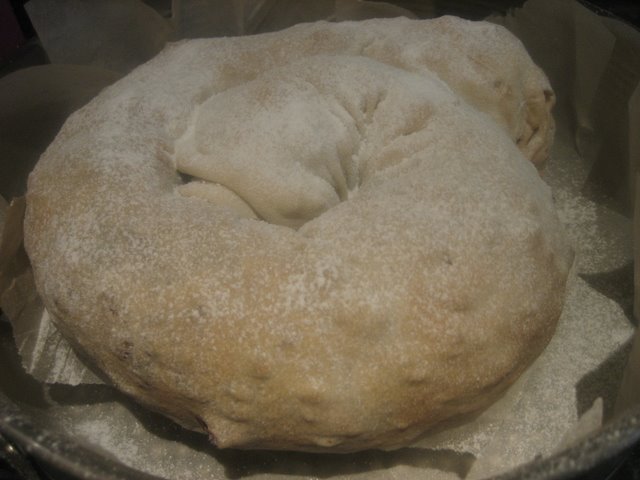
Rocciata di Assisi


On the Italian forum on Egullet it is the month dedicated to Umbria, so, yeasterday, invited for brunch at a friend house, I thought of bringing over this dessert: Rocciata di Assisi.
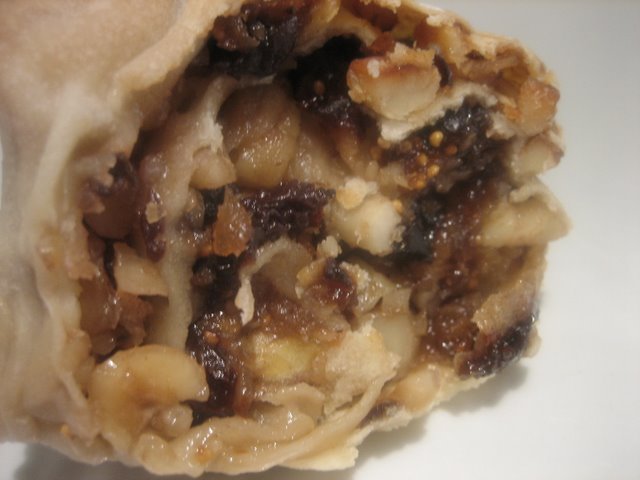
It's a strudel with a rich dry fruit filling, shaped into a coil.
Oretta Zanini Devita in her collection of regional recipes gives some history of this dessert. In Assisi "roccia" means round, hence the origin of the name comes from the shape. It is an ancient cake born in Medioeval times with a legacy coming from the Ostrogoths and Longobards. Although she talks about an ancestor of rocciata, in the Tavole Eugubine on which habits and costumes of 2000 years ago are drawn, "tensedio" , giving no description but just saying it was in honor of the God Hondo Ceffio. Through these tables was possible to describe the umbrian cesna, the banchet.

I've seen so many different versions of rocciata on the web. Next time, I think I will bring down the dry fruit to 350 and make up the difference to 500 asked in this recipe with more apples, in any case it's a good dessert for a dry fruit lover.

Filling

500 g of mix dry fruit (zibibbo, sultanas, dry figs finely diced, dry prunes finely diced, walnuts and almonds coarsely chopped)
one apple, peeled and diced
100 g sugar
1 teaspoon cinnamon
lemon zest and some juice
2 tablespoons vinsanto

Mix and let rest covered for couple hours.

For the dough

250 g flor
50 g sugar
salt 1/2 teaspon
2 tablespoons of oil
water enoght to form a silky smooth dough.

Let rest under a bowl for 1/2 an hour.

Roll out the dough as thin as possible. I streched with my fists under the dough as for a strudel. Spread the filling leaving little space at the hedges, roll with the help of a kitchen towel, shape into a coil, brush with evo and bake in a preheated oven at 190, for about 30 minutes or more, until nicely golden. When cold dust with 10X.

  Posted by Picasa

Monday, October 02, 2006

Caprese

Caprese is a cake from Campania, its peculiarity is the absence of flour and baking powder. Some recipes require crumbled fette biscottate (french toast) but I like without.
If you like chocolate cakes, this caprese will not disappoint you, it's moist, rich but not heavy, it's really a fantastic recipe.


The original recipe was posted by Lydia Capasso on the Italian Forum of Cucina Italiana.

Leaving the same quantities, I completely changed the method, getting -in my opinion -a better result. It is a very moist cake and doesn't cling to your palate. It keeps well for several days with no refrigeration and actually improves its taste.

It doesn't contain flour, so it's also a perfect cake for gluten intollerants.

140 g sugar
140 g bittersweet chocolate
140 g unsalted butter
140 g unpeeled almonds
210—230 g eggs total whole weight (about 4 small eggs)
1 pinch of salt


These quantities are ok for a 20 cm diameter mold.

Preheat the oven at 200 C. Butter and flour your mold.

I slightly toasted the almonds in the oven and when cold grated in the mixer (I have a bosch mixer with the grating dish, make a perfect flour without overheating the almonds), alternatively you can pulse the almonds in the coffe grinder with a couple teaspoons of sugar (taken by the recipe quantity). Leaving the almonds with the peel is a little tastier, more rustic flavour.

I grated the chocolate with the fine microplane.

Whip the soft butter with the sugar until very light and foamy, add the yolks one at the time, add the chocolate (here, half of the chocolate was just grated, the other half I decided to melt, let cool before adding), then add the almond flour and alternate with a little bit of whipped egg whites. Fold in remaining egg whites. Pour in the mold and level with a spatula. Bake at 200 C for 5 minutes, then reduce to 170 for about 30-35 minutes, check toward the end.

Bitter almonds are not a bad addiction, you could use some in place of the regular one but don't use almond extracts, the most of the time are nasty. Instead,if you like, you can add some vanilla essence.

Do not overbake, it's important it stays moist. Serve with creme anglaise, or gelato, or simply dusted with 10X.

  Posted by Picasa

Thursday, September 28, 2006

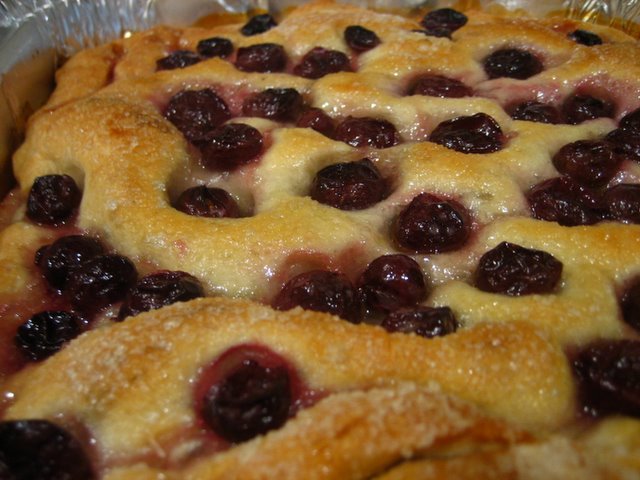
Schiacciata con l'uva

Before trying this schiacciata, I honestly didn't think I was going to like it so much.
This is just my kind of dessert, a nice crunchy border with a good olive oil taste and the soft and juicy grape...I really don't like complicated dessert, with creams and mousses, I get bored after 2 bites.
Schiacciata con l'uva is a traditional sweet bread from Toscana, doesn't require more than a good bread dough, good extra virgin, grape and sugar. It's typical of haverst season because it must be made with black wine grape.

The recipe is not really necessary but more or less I did this way:

200 g of bread flour
salt 2% of the weight of the flour (a scarce teaspoon)
8 g of fresh yeast cake
a dizzle of evo
and enough water for a soft but not sticky dough

I did let it proof twice. I cleaned and washed the grape (about double weight than the amount of flour). Divided the dough in half, spread the first half in a small oiled baking pan. Let rest a little if the dough resist and wet your hands with oil. It should be rolled out very thin, spread half of the grape, gently press down on the dough, drizzle with oil and sprinkle with sugar. Repeat with the remaing half of dough and grape. Pinch the hedges and bake in a preheated oven at about 180 celsius for about 50 minutes. I let it slide on a grate because I didn't want it to get to soft, the filling keeps it very juicy anyway.


  Posted by Picasa